
NEWS
The Adoption and Signing of the Abia State Mini-Grid Regulation: 5 Things to Know by Dodoh Okafor

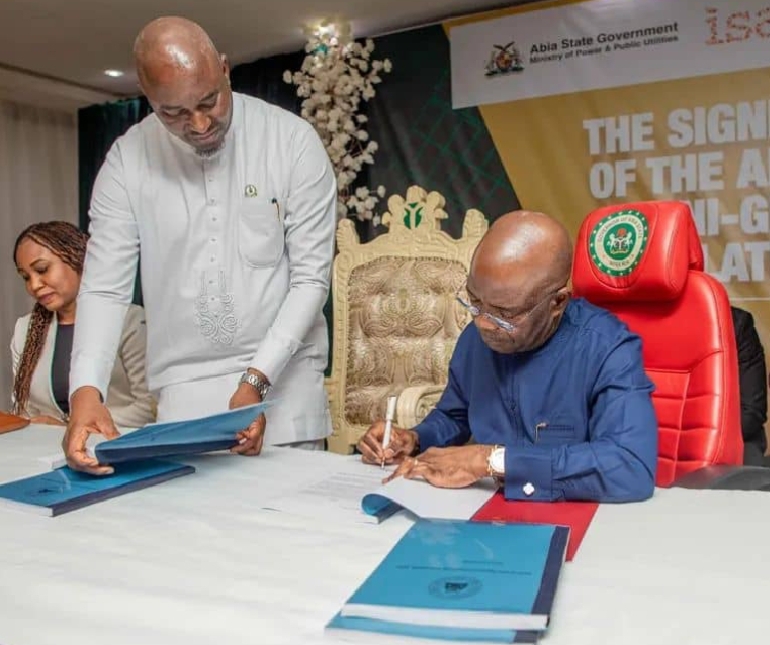
On Wednesday, September 10, 2025, the Abia State Government led by Governor Alex C. Otti, OFR, signed a Memorandum of Understanding with the International Solar Alliance and formally adopted the State’s Mini-Grid regulatory framework.
The central idea of the initiative as the Governor said at a well-attended event at the Banquet Hall of the Government House Umuahia was to create a pathway to reliable electricity supply for our people in the un-served and under-served communities. Central elements of the Mini-Grid Regulatory framework as adopted include the protocols for registration and licensing, pricing, dispute resolution, interconnectivity, infrastructure sharing, and assets transfer.
The document is as comprehensive as it can be, although the Governor in his usual modesty acknowledged that as technology and market realities changes, adjustments would be made here and there to keep the system responsive to the needs of the population.
I was at the stakeholder interaction organized for the presentation and critique of the framework on Tuesday, September 9, 2025 in Umuahia before it was adopted and signed a day later by the Governor. It was an interesting engagement with participants drawn from several continents and different walks of life. I also followed the events at Banquet Hall where His Excellency signed the memorandum of understanding and announced the formal adoption of the framework. I picked very interesting lesson from the programmes and as always, I am glad to share what I learnt.
1. Steady electricity for everyone: Yes, this is quite self-explanatory. The formalisation of protocols and systems for the operation of mini-grids in the State would literally mean steady electricity for everyone, whether you live in rural or urban centres, whether your needs are residential or commercial, whatever the size of your bank account and perhaps, no matter the political party you support. Those of us on this side would also get the same amount of goodies as our friends on the opposing side. What the new mini-grid regulation means is that a framework to spur and direct the pattern of investments in mini-grid electricity in the State has been set in motion. A structured business ecosystem will ultimately attract investments, more investments means serious commercial and technical competition and ultimately, a better deal for customers. There is clearly a lot to be optimistic about in the energy enterprise space in the State and the recently-adopted mini-grip regulatory framework is just one of them but then, it may also be the most significant and most likely-to-be-achieved in the short to medium term.
2. Closing the experience gap between urban and rural centres: Why often many of us move to the urban centres from our village homes is to find the opportunities and privileges that come with more electricity supplies as is the case in the urban communities. Yes, power supply in Nigeria is generally below par but I am more likely to get high supply numbers if I live around Library Avenue Umuahia than if I stayed back in my village. To be clear, our need for electricity goes beyond the appetite for night time illumination — electricity is productivity. You are therefore most likely to be more productive in places where the power supply is regular than where it is not. If you live in Umuahia, your standard of life is likely to be higher than someone living in a rural community because one, you are likely to earn more, meaning that your consumption choices are likely more expansive. It is also more likely that you will have access to the finer things of life, drink cooler water and maybe spend less time sweating. But things will change rapidly with the coming of the mini-grids, everyone will have the right to gloat, good things would be more evenly spread and the man in my village can also afford to employ the machines and tools that boost productivity and thus, reach higher income levels and if you stretch it further, expand the size of their consumption baskets. The implication is that the rush to the urban centres will slow as more people begin to find interesting path to their dream realities right in the places where they were born.
3. Industrialisation, employment and more: Our industrial output levels are low because power has been a perennial constraint. With more investors coming into the energy space, using innovative means to generate and transit electricity to users in homes and factories, our output volume are bound to rise as new machines are installed and long abandoned machineries deployed to support the process of producing more goods and services. What would ultimately follow are increased demand for labour, shorter unemployment queues and then a rise in the bargaining power of workers as opportunities multiply. This reality is great for the economic and social experiences of our young people.
4. Optimising renewable energy sources: We are a community blessed with the natural resources that can be harnessed to generate energy. From sunlight to wind and other sources that already exist for the generation of zero to low carbon electricity and the ones that would be invented in the future. What the Abia State mini-grid framework would ultimately do is to open our eyes to the untapped resources that would support our push for energy-sufficiency here in the State.
5. An opportunity to invest in the electricity value chain for all of us: Yes, the message is that going forward, anybody, including community associations and town unions, you and I, cooperative societies and all of us can become an investor (investors) in the renewable energy business, using non-carbon sources to generate and transmit electricity to users in different parts of the State. The good news for us is that the Government has set up modalities for supporting everyone wishing to invest in mini-grid electricity in the State, from the State Ministry of Power and Public Utilities to the Board of the Abia State Electricity Regulatory Authority (ASERA), there are institutional structures that are willing to guide anyone making an inquiry, bringing their money to invest or needing a structure to guide their financial outlay. Do not miss this opportunity to be part of the electricity revolution happening in the State. People are already seeking to know how they can come in and support in the provision of stable electricity in their villages and communities. Please hurry to the aforementioned offices to learn what you need, the existing infrastructure and what you need to pay as registration and licensing fees and of course, how much returns can be made in an area over time. The direction is clear: invest or lose the right to accuse some external factors of being behind the malaise of poor electricity infrastructure and structure in the places that matter to you, where you live, do business or play. It is now up to us what we do with the opportunity that the new system, supported by Governor Alex Otti, OFR and his astute team at the Ministry of Power and Public Utilities, is offering us. Don’t sleep on it.